Popular Searches:
Displaying top search terms based on the last 90 days.
Popular Searches:
Displaying top search terms based on the last 90 days.


If you’ve spent any time around contractors, landscapers, equipment operators, or property owners lately, you’ve probably noticed more tilt trailers showing up on jobsites, farms, and roadways. What was once considered a specialized trailer option has become one of the fastest-growing segments of the equipment hauling market.
The reason isn’t complicated. People are constantly looking for ways to make loading equipment faster, safer, and less frustrating. Traditional trailers still have their place, but many owners are discovering that tilt trailers solve several common problems that have existed for years.
Whether you’re hauling skid steers, compact tractors, utility vehicles, mini excavators, or other equipment, a tilt trailer offers a level of convenience that’s difficult to ignore once you’ve experienced it firsthand.
One of the biggest reasons buyers are switching to tilt trailers is the loading process itself.
Traditional equipment trailers typically rely on ramps. While ramps are effective, they require additional setup time and can become cumbersome when equipment is being loaded and unloaded multiple times throughout the day. Operators must deploy the ramps, load the equipment, secure the ramps again, and repeat the process at every stop.
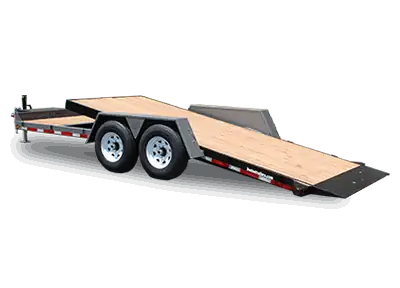
A tilt trailer eliminates much of that hassle. Instead of dealing with ramps, the trailer deck tilts to create a loading angle that allows equipment to be driven directly onto the trailer.
It may only save a few minutes at each stop, but for contractors who load equipment daily, those minutes add up quickly. Over the course of a year, the time savings can be substantial.
Ask anyone who regularly hauls equipment, and they’ll likely tell you that ramps eventually become one of the most annoying parts of trailer ownership.
Heavy ramps can be awkward to handle, especially after a long workday. They can become damaged, misplaced, or difficult to operate if dirt and debris build up around mounting points. In some situations, they can even create safety concerns if not secured properly.
Tilt trailers remove this issue entirely. Because the deck itself provides the loading angle, there’s no need to lift, carry, or store ramps.
Many owners don’t fully appreciate this benefit until they’ve spent years dealing with traditional trailer ramps. Once they switch, it’s often one of the first features they mention.
Equipment loading is one of the most critical moments during transportation.
Whenever equipment moves between the ground and a trailer, there is potential for accidents. Steep loading angles, slippery ramps, and uneven ground conditions can all increase risk.
Tilt trailers often provide a smoother transition between the ground and the trailer deck. This can help improve operator confidence while reducing some of the challenges associated with loading equipment on traditional ramps.
While safe loading practices should always be followed regardless of trailer type, many operators find tilt trailers easier and more predictable to use in a variety of jobsite conditions.
Another reason tilt trailers continue gaining popularity is their versatility.
Many owners initially purchase a trailer with one specific machine in mind. Over time, however, hauling needs often change. A trailer that was originally purchased for a skid steer may eventually be used for a compact tractor, utility vehicle, mini excavator, or other equipment.
Tilt trailers accommodate a wide variety of equipment types, making them attractive for contractors and property owners who regularly transport different machines.
This flexibility helps maximize the trailer’s usefulness while providing value across multiple applications.
Contractors tend to evaluate equipment differently than recreational users.
For many contractors, every minute spent loading equipment is time that could be spent completing billable work. Small inefficiencies may seem insignificant on a single job, but they become much more noticeable when repeated every day.
Tilt trailers help streamline loading operations and reduce the number of steps required to get equipment on the road. That efficiency is one of the primary reasons many landscaping companies, excavation contractors, and construction businesses are increasingly choosing tilt trailers over traditional equipment trailers.
The less time crews spend handling ramps and positioning equipment, the more time they can spend actually working.
Some equipment simply loads better on a tilt trailer.
Machines with lower ground clearance, specialty attachments, or unique wheel configurations can occasionally struggle with steeper loading angles found on traditional ramp systems. Depending on the trailer design, operators may encounter issues with scraping, dragging, or difficult transitions during loading.
Many tilt trailers offer a smoother loading angle that helps reduce these concerns. This can make them particularly appealing for owners hauling specialized equipment or machines that require extra care during transportation.
The result is often a more comfortable loading experience and less stress on both the equipment and the operator.
While functionality is usually the primary concern, appearance matters too.
Many contractors invest heavily in maintaining a professional image. Customers notice equipment, trucks, and trailers long before work begins. Clean, modern equipment can help reinforce confidence and create a positive first impression.
Tilt trailers often have a streamlined appearance that many buyers find appealing. Combined with their ease of use, they can become a valuable part of a company’s overall professional presentation.
For growing businesses, that image can be just as important as the trailer’s technical capabilities.
Despite their growing popularity, tilt trailers aren’t necessarily the perfect solution for every buyer.
Traditional equipment trailers remain an excellent choice for many applications. Factors such as equipment type, hauling frequency, budget, and personal preferences should all be considered before making a decision.
The key is understanding how you’ll actually use the trailer. For operators who load equipment frequently and value convenience, a tilt trailer often becomes an attractive option. For others, a traditional trailer may still provide everything they need.
Comparing both styles side-by-side is often the best way to determine which design makes the most sense for your operation.
As equipment hauling needs continue to evolve, it’s easy to understand why more buyers are turning to tilt trailers. The combination of faster loading, improved convenience, reduced ramp handling, and increased versatility makes them an appealing choice for a wide range of industries.
For buyers considering a tilt trailer, there’s no substitute for seeing different models in person and comparing how they operate. Contractors, landscapers, farmers, and property owners often discover that the right trailer becomes obvious once they can evaluate the loading process firsthand. With more than 500 trailers in stock and available for pickup, Brechbill Trailers gives buyers the opportunity to compare tilt trailers and traditional equipment trailers side-by-side before making a decision.
Choosing the right trailer isn’t just about capacity. It’s about finding a trailer that helps you work more efficiently every time you hit the road.
A tilt trailer uses a tilting deck instead of traditional loading ramps, allowing equipment to be driven directly onto the trailer.
It depends on the application. Many buyers prefer tilt trailers because they simplify loading and eliminate the need to handle ramps.
Tilt trailers are commonly used for skid steers, compact tractors, mini excavators, utility vehicles, lawn equipment, and other machinery.
Many operators appreciate the convenience, faster loading process, improved safety, and versatility that tilt trailers provide.