Popular Searches:
Displaying top search terms based on the last 90 days.
Popular Searches:
Displaying top search terms based on the last 90 days.

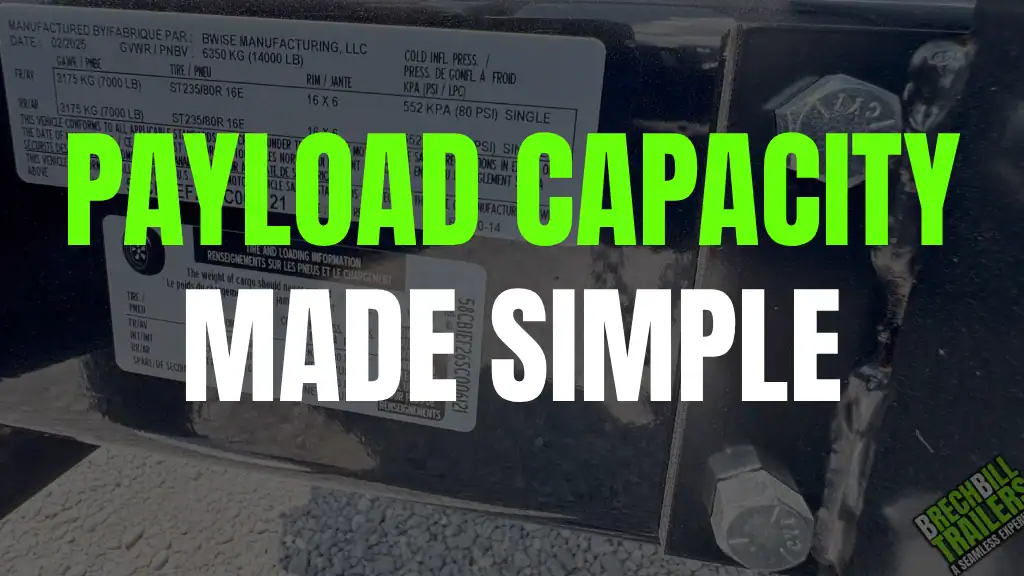
When you’re shopping for a new trailer, there’s one set of numbers that matters just as much as the brand, size, or price: the weight ratings. GVWR and payload capacity are two of the most important specs you’ll see on a trailer’s ID tag, but many buyers aren’t sure what they really mean or how to calculate them.
The truth is, getting these numbers wrong can lead to major problems. Overloading a trailer doesn’t just cause faster wear and tear. It puts you, your cargo, and everyone else on the road at risk. That’s why understanding GVWR and payload capacity is one of the smartest steps you can take before signing the paperwork.
In this guide, we’ll break it down step by step, show you how to calculate the numbers yourself, and share specific tips for Pennsylvania haulers.
GVWR stands for Gross Vehicle Weight Rating. Think of it as the maximum safe weight of the trailer when fully loaded. That includes:
If your trailer’s GVWR is 10,000 pounds, that means the combined weight of the trailer and everything you put on it can’t exceed that number.
Payload capacity is slightly different. Instead of describing the total maximum weight, payload capacity tells you how much cargo the trailer can safely carry. Here’s how it works…
Payload Capacity = GVWR – Trailer’s Empty Weight
For example:
That 7,000 pounds is what you can safely load.
Every trailer comes with a Gross Vehicle Weight Rating (GVWR), which is the maximum weight the trailer is designed to safely carry, including its own weight. You’ll usually find this number printed on the VIN or ID plate, often located on the tongue or frame of the trailer. If you can’t find it there, it should also be listed in the owner’s manual.
Next, you need to know how much the trailer weighs on its own before you load anything onto it. This is often called the curb weight or dry weight. Many manufacturers include this number on the spec sheet or in the owner’s manual. Dealers often list it in their sales information too. If you can’t find it in writing, the most reliable method is to take the trailer to a certified scale and weigh it yourself.
Once you have both numbers, calculating payload capacity is simple. Just subtract the empty weight from the GVWR. The result tells you how much cargo your trailer can safely handle. For example, if your trailer has a GVWR of 12,000 pounds and an empty weight of 4,000 pounds, your payload capacity is 8,000 pounds. That’s the maximum amount of equipment, materials, or goods you can load without overloading the trailer.
Pennsylvania has its own unique conditions that make weight ratings even more important:
One of the biggest mistakes buyers make when shopping for a trailer is confusing axle rating with the trailer’s GVWR. Just because you see two 7,000-pound axles doesn’t automatically mean the trailer can legally or safely carry 14,000 pounds. The frame, coupler, and even the tires play just as big a role in determining the overall capacity.
Another common oversight is forgetting about tongue weight. Payload isn’t limited to what sits on the deck. Part of that load transfers to your tow vehicle through the hitch, and that weight matters just as much when it comes to safety and compliance.
Many buyers also guess at cargo weight instead of verifying it. A skid steer, for example, might look like it weighs around 5,000 pounds when in reality, with attachments and fuel, it pushes closer to 7,000. Relying on rough estimates is one of the fastest ways to overload without realizing it.
And finally, people often buy trailers that only fit their immediate needs. A setup that barely works today may leave you stuck tomorrow when you take on bigger jobs or upgrade equipment. Thinking ahead is just as important as meeting current requirements.
Knowing a trailer’s GVWR is only half the equation! You also need to make sure your truck or SUV can safely handle it. Start with the towing capacity listed in your owner’s manual, not what you find on a forum or a quick Google search.
Manufacturers publish official ratings for a reason, and relying on guesses can put you at risk. From there, pay attention to the Gross Combined Weight Rating (GCWR), which represents the maximum weight of your loaded vehicle plus your loaded trailer together. Exceeding this number is not only dangerous but could also put you out of compliance.
Load balance is another detail that gets overlooked. A safe setup typically has around sixty percent of the weight positioned forward of the trailer’s axles. This keeps the trailer stable on the road and helps prevent swaying. Tongue weight plays into this as well. Generally, you want ten to fifteen percent of the trailer’s total loaded weight carried on the hitch.
If your hitch isn’t rated for that amount, you’ll run into serious handling problems, even if the trailer itself is within limits. Matching your tow vehicle and trailer correctly is about looking at the entire system, not just one number on a spec sheet.
Pennsylvania adds its own challenges for trailer owners. Weigh stations and CAT scales are scattered throughout the state, and they’re worth using to confirm your actual loaded weight before you hit the highway. Registration is another factor many overlook. In Pennsylvania, your trailer’s registration class is tied directly to its registered gross weight. If you exceed that number, you could face fines or even be required to re-register at a higher class.
Braking rules are also strict. Any trailer over 3,000 pounds must be equipped with brakes on all wheels. That means if you’re pushing the upper limits of your GVWR, it’s smart to double-check that your system is compliant. Between steep grades, heavy traffic, and winter road conditions, Pennsylvania doesn’t leave much room for error. Staying ahead of these requirements not only keeps you legal but also keeps you safe.
It’s also very important that you understand how to properly load a trailer, as it can prevent a disaster like this one.
Before you sign the paperwork on a new trailer, there are a few essentials you’ll want squared away. Make sure you understand the GVWR and the true payload capacity of the trailer, and confirm that your tow vehicle is actually rated to handle the combined weight. Think about your heaviest hauling scenarios rather than just day-to-day jobs. Planning for the toughest load you’ll carry keeps you from being stuck later.
Ask the dealer to show you the trailer’s specs in writing so there’s no guesswork. And finally, consider where your business or needs might be headed in the future. A little extra capacity today could save you from having to upgrade again a year or two down the road.
Calculating GVWR and payload capacity isn’t complicated, but it’s one of the most important steps you can take before buying a trailer. By understanding these numbers, you’ll avoid safety risks, stay compliant with Pennsylvania law, and ensure your investment lasts.
We help customers every day match the right trailer to their hauling needs. If you’re unsure about weight ratings or want to see a wide range of options with clear specs, stop by our Chambersburg location or browse our current inventory online.