Popular Searches:
Displaying top search terms based on the last 90 days.
Popular Searches:
Displaying top search terms based on the last 90 days.


Gooseneck trailer cost is usually the first thing that hits people when they start shopping, and it’s also the most confusing. One trailer is listed at $7,500, another looks almost identical at a glance but costs $18,000, and then there are heavy-duty rigs pushing $30,000 or more. From the outside, it’s not always clear why the prices are that far apart.
The reality is that gooseneck trailers aren’t a single, standardized product. They’re more like a platform that gets built up piece by piece. Size, weight rating, frame design, axle setup, suspension, ramps, hydraulics, and even paint quality all stack on top of each other. Every one of those choices adds cost or saves it, and it shows up fast on the price tag.
The short answer is that a new gooseneck trailer cost typically lands somewhere between $6,500 and $30,000+, depending on what the trailer is actually built to handle. The more important answer is understanding why that spread exists and which parts of the price actually matter for the way you plan to use it.
For most buyers, gooseneck pricing falls into a few broad categories based on capacity and purpose.
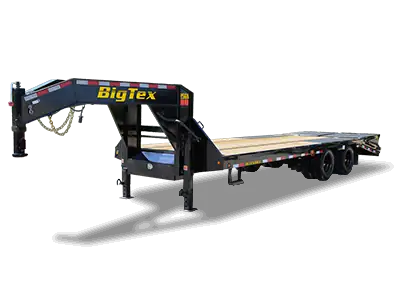
At the lower end are 14K flatbed gooseneck trailers, usually priced between $6,500 and $11,500. These are the everyday workhorses for hauling cars, compact tractors, skid steers, and lighter equipment. Entry-level models often use channel frames and manual ramps. Higher-priced versions in this range step up to heavier I-beam frames, tighter crossmember spacing, and better running gear.
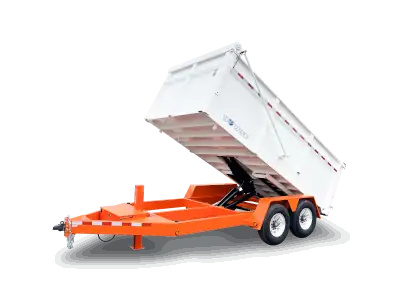
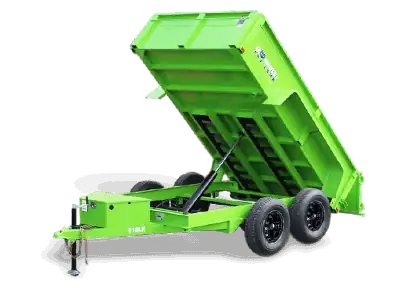
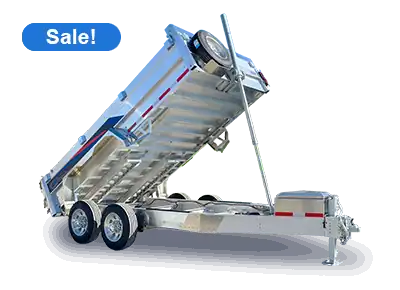
Once hydraulics enter the picture, prices jump. 14K gooseneck dump trailers typically fall in the $12,000 to $16,500 range. That price increase isn’t random. You’re paying for a scissor or telescopic hoist, thicker steel walls, reinforced frames, batteries, wiring, and controls. Even if two trailers share the same GVWR, the dump trailer is dramatically more complex.
At the top end are 25K+ heavy-duty and hotshot gooseneck trailers, which start around $16,000 and can climb past $30,000 depending on configuration. These trailers are built for daily commercial use. Which is why they have dual tandem axles, engineered frames, heavy brakes, wide decks, and advanced loading systems like hydraulic dovetails.
So clearly, a lot of the gooseneck trailer cost is based on the type of trailer you’re getting. Let’s get into the details…
More than any other component, the frame dictates the gooseneck trailer cost.
Lower-priced goosenecks often rely on standard channel steel. It works, it’s affordable, and it keeps manufacturing costs down. For light to moderate use, there’s nothing inherently wrong with it.
As you move up in price, you start seeing heavy-duty I-beam frames or engineered beams. These frames aren’t just thicker; they’re designed to handle stress more efficiently.
Material is removed where it isn’t needed and reinforced where it is. That reduces trailer weight while increasing strength, which means higher usable payload.
This kind of engineering costs more to design and manufacture, but it’s one of the reasons higher-end trailers feel more stable under load and age better over time.
Brands like Big Tex Trailers, Horizon Trailers, and Southland Trailers all approach frame design differently, and that philosophy shows up directly in price.
Ramps look simple, but they’re one of the clearest cost indicators.
Basic slide-in or stand-up ramps are the cheapest option. They work, but they require manual handling and storage.
Step up to spring-assisted mega ramps, and you’ll usually add $500 to $1,000. These wider, easier-to-use ramps are a big quality-of-life upgrade for anyone loading equipment regularly.
The most expensive jump comes with hydraulic dovetails. A hydraulically controlled rear deck section that raises and lowers at the push of a button can add $3,000 to $5,000 by itself. For hotshotters or operators loading heavy equipment all day, that feature can be worth every penny. For occasional users, it may be overkill.
This single option explains why two trailers that look similar in photos can be priced worlds apart.
Running gear is where budget trailers quietly show their limitations.
Most standard goosenecks come with electric brakes and leaf-spring suspension. That’s fine for many applications. But upgrades add cost quickly.
Moving to electric-over-hydraulic (EOH) brakes improves stopping power and control, especially under heavy loads, but typically adds $1,500 to $2,500.
Some higher-end goosenecks offer torsion axles or even air ride suspension, which dramatically improve ride quality and reduce stress on both trailer and cargo. Those upgrades can add $4,000 or more, but they’re aimed squarely at professional haulers running long distances.
You’ll also see cost differences in axle brands, hub types (oil bath vs. grease), and tire packages. All of that affects price and longevity.
Paint is one of the most misunderstood gooseneck trailer cost, so let’s skip past the technical jargon and marketing terms and get into the facts.
Cheaper trailers often have basic paint systems. They look fine on the lot but chip easily and allow rust to creep in fast, especially in northern states.
Higher-priced trailers invest in multi-stage powder coating, often with a primer layer underneath. That prep work takes time and money, but it slows corrosion dramatically and protects welds, seams, and fasteners.
Over five or ten years, that difference can mean hundreds or thousands of dollars saved in repairs, or resale value retained. Brands like Bwise Trailers and Horizon Trailers tend to land higher on the price spectrum partly for this reason.
The “right” price depends entirely on how the trailer will be used.
If you’re hauling cars, compact equipment, or light loads occasionally, a 14K flatbed in the $7,000 – $10,000 range may be perfect.
If you’re dumping material regularly, a $13,000 – $16,000 dump trailer is realistic.
If you’re hauling heavy machinery, running hotshot loads, or pulling thousands of miles a month, that $20,000–$30,000 gooseneck starts to look like a tool, not a luxury.
We offer a large variety when it comes to dump trailers, so feel free to browse our selection online or visit our lot in Chambersburg, PA to learn more!

Eric Wolf
08/18/2026
Absolute wonderful service today. I was passing through the area on a cross country trip with my travel trailer. During a fuel stop that happened to be near their shop, I noticed that my leaf spring hanger was severely damaged. In talking with one of the service techs, he told me that if I was able to limp it to their facility they would be able to get me back on the road in no time. From the time I unhooked the trailer on their lot until I was hooked back up and on my way was about 90 minutes. They were absolutely wonderful and communicated the whole time. The price was exceptionally reasonable considering it was an emergency on my end. I wish I lived closer so they could become my full-time shop! They took a very stressful situation and were able to really help me out in a bind. Thank you again!

Jordan Wiggins
05/01/2026
Best place to buy a trailer. We grabbed a 6x12x4 dump trailer. Quinn made sure the process was easy and smooth! Such a great guy, came with my three boys (3,6 & 8) and he made them feel right at home. Jared spoiled my kids with snacks!!! lol Great team! Thanks you all

Dan Tabler
05/01/2025
Great place to do business, no pressure very professional and they don’t try to push you into anything. I got several quotes and overall they are the best value

Jonathan
04/30/2025
Had a fantastic experience. Super friendly and helpful staff made my out of state purchase quick and painless. Very knowledgeable and the best prices I could find for hundreds of miles. Highly recommend!

Scot Evans
04/29/2025
I came a very long distance and worked with Shane over a three week period, and I must say from day one through the day I picked up my unit, the service was outstanding. Not only do they sell superior products, but the customer service is top-notch. Thank you, Brechbill Trailer Sales!

Jeffrey Bagley
04/29/2025
Purchased a new Eby dump trailer. Great experience during both a phone order/ purchase, and on my pick up / delivery day. No hidden fee’s or surprises. I would recommend them as everyone I encountered was very positive and helpful.

Cystal Garrett
04/25/2025
We brought our B wise dump trailer to Jud for things that needed fix and he did an awesome job. Also we had a local Chevy dealer install a brake controller on our 2023 Tahoe, after the 3rd controller, we had Jud look at it. Jud found that the Chevy dealership installed them wrong and it was burning the brake controller module up. Jud took the time to replace it and install a new one for us, he is very professional and explained everything to us. 10 out of 10, we will be back to Brechbill for anything trailer related. Jud definitely earned our trust..