Popular Searches:
Displaying top search terms based on the last 90 days.
Popular Searches:
Displaying top search terms based on the last 90 days.


If you’ve been around dump trailers long enough, you know this question never gets a straight answer on job sites. Ask five people how many yards their trailer holds and you’ll hear five different numbers, all spoken with confidence. The problem isn’t that people are lying. The problem is that “yards” means almost nothing without context.
A dump trailer doesn’t care how many cubic yards fit inside its walls. It only cares how much weight you’re asking it to carry, stop, dump, and survive repeatedly without destroying itself. That disconnect between volume and weight is where most expensive mistakes come from.
This isn’t one of those articles that just throws a chart at you and calls it a day. Instead, let’s talk about how dump trailers actually behave in the real world, why some loads feel “fine” until they aren’t, and how experienced operators really think about yards.
A cubic yard is a measure of space, not stress. Dump trailers fail because of stress. Axles flex. Tires heat up. Frames twist. Hydraulics struggle. None of those failures happen because the box was full. They happen because the trailer was overloaded relative to how it was built.
Two trailers with the same bed size can have wildly different real-world limits. One might haul material for years without issues, while another starts cracking welds and killing tires after a single season. From the outside, they look identical. Underneath, they are not.
That’s why yards should always be treated as a secondary number. The primary number is payload capacity. Yards only make sense after you understand weight.
Most people assume bigger box equals more usable yards. Sometimes that’s true. Often it isn’t.
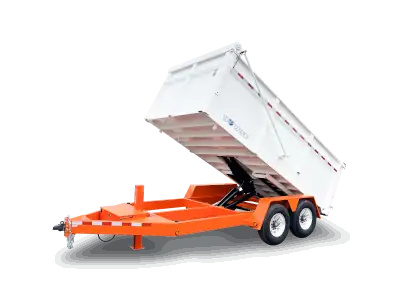
A seven-by-fourteen dump trailer with tall sides can physically swallow five yards of material. It looks impressive. It also routinely gets overloaded because five yards of anything other than mulch is asking a lot from a 14K trailer. That’s how people convince themselves they need new tires every year or wonder why their trailer never seems to dump smoothly.
Smaller dump trailers actually survive better in the hands of new owners because they hit their limits sooner. A five-by-ten doesn’t tempt you the same way. You physically can’t load it full of rock without noticing something is wrong. Larger trailers hide the problem until damage is already happening.
Dirt is where a lot of people get comfortable and stop paying attention. It doesn’t look that heavy. It piles clean. It feels manageable, right up until it gets wet.
Dry topsoil usually weighs around two thousand pounds per cubic yard, which already surprises most first-time buyers. Add moisture and that number can jump to twenty-five hundred pounds per yard or more. After a good rain, the question of how many yards you can haul changes fast, even if the trailer hasn’t changed at all.
That’s why experienced operators don’t load dirt to the top rail. They load to a mental limit they’ve learned the hard way, often counting bucket scoops instead of eyeballing volume. They understand that how many yards worked yesterday might be too much today if the soil is saturated or packed tighter.
When you haul dirt regularly, there is no single answer to how many yards a dump trailer can hold. It depends on weather, soil type, and how much abuse you’re willing to put on your trailer over the long run.
Gravel is honest in a brutal way. It punishes mistakes quickly.
Most gravel weighs somewhere between twenty-seven hundred and three thousand pounds per yard. You don’t need much of it to overwhelm a light dump trailer. Even trailers that feel stout start showing strain when gravel becomes a daily material.
This is why you’ll see gravel loads that look disappointingly small. That’s not inexperience. That’s discipline. Three yards of gravel is often the upper limit for many fourteen-thousand-pound dump trailers once you account for the trailer’s own weight.
People who overload with gravel usually get away with it exactly once. Then they’re pricing tires, brakes, or suspension parts earlier than expected.
Rock is where the idea of yards falls apart completely.
Decorative stone, riprap, and larger aggregate can weigh over three thousand pounds per yard. The box might still look half empty, but the trailer knows the truth. Hydraulics struggle more. Dump angles matter more. Frame flex becomes obvious.
This is also where people discover the difference between a trailer that can dump and one that likes to dump. A trailer that handles mulch effortlessly may lift rock slowly, unevenly, or not at all. That strain doesn’t disappear after the bed comes back down. It stays in the metal.
With rock, many dump trailers are realistically limited to one or two yards. That surprises people, but it’s also why the trailers that survive rock hauling tend to be heavier, more expensive, and spec’d differently from general-purpose models.
Mulch is the material that tricks everyone into thinking their trailer is stronger than it is.
Mulch is light. Even wet mulch is light compared to everything else. That’s why you see dump trailers piled high with it, sideboards flexing, and tailgates barely visible. From a weight perspective, it’s usually fine.
This creates a dangerous mental shortcut. Owners get used to seeing their trailer full. Then they switch to dirt or gravel and load it “about the same” without realizing the massive difference in weight. The trailer doesn’t complain immediately, but the damage starts accumulating.
Mulch loads are not a benchmark for capacity. They’re an exception.
Side height increases volume far more than it increases safe capacity. A trailer with tall sides feels more capable because it holds more material by sight alone. In reality, the axles, tires, and frame don’t care how tall the box is. They care how much force is going through them.
This is why tall-sided dump trailers are often paired with warnings from experienced dealers. They’re great for light materials and terrible at encouraging restraint with heavy ones. A tall box on a marginally rated trailer is a recipe for accidental overloading.
Professionals almost never talk in yards when loading a dump trailer. They talk in buckets, machine sizes, and “feel.”
A skid steer bucket holds roughly half a yard when loose, less when carrying dense material. Once you’ve blown a tire or bent a ramp, you stop guessing. You count buckets. You know when to stop early. You know what your trailer doesn’t like.
This isn’t because experienced operators are cautious by nature. It’s because they’ve paid the tuition.
The One-Time Overload Myth
Almost everyone overloads their dump trailer once and thinks it was fine. The trailer dumps. The lights still work. The drive home feels normal.
What actually happened is the trailer used up a chunk of its future lifespan in exchange for one job. Springs flattened slightly. Bearings ran hotter. Welds took stress they weren’t designed for. None of that shows up immediately.
Dump trailers usually don’t fail dramatically. They fail quietly, over time, and overloaded yards are the reason more often than anything else.
The Right Way to Think About Yards
A better question than “how many yards can this trailer hold” is “how many yards should I haul if I want this trailer to last.”
That answer depends on material density, moisture, trailer construction, and how often you’re hauling. It also depends on whether the trailer is a tool you rely on or something you’re willing to abuse and replace.
The trailers that last the longest are usually underloaded slightly and never used to their maximum visual capacity. That’s not wasted potential. That’s smart ownership.
Here’s the part people don’t love hearing.
If you routinely haul heavy materials, your trailer’s “yard capacity” is probably lower than you think. And if you’ve never had an issue, that doesn’t mean you’re doing it right. It just means the bill hasn’t arrived yet.
Dump trailers make money when they work quietly and predictably for years. They lose money when they’re pushed to impress instead of built to endure.
Want to take a look at a wide selection of dump trailers in person? Visit our lot in Chambersburg, PA today!

Eric Wolf
08/18/2026
Absolute wonderful service today. I was passing through the area on a cross country trip with my travel trailer. During a fuel stop that happened to be near their shop, I noticed that my leaf spring hanger was severely damaged. In talking with one of the service techs, he told me that if I was able to limp it to their facility they would be able to get me back on the road in no time. From the time I unhooked the trailer on their lot until I was hooked back up and on my way was about 90 minutes. They were absolutely wonderful and communicated the whole time. The price was exceptionally reasonable considering it was an emergency on my end. I wish I lived closer so they could become my full-time shop! They took a very stressful situation and were able to really help me out in a bind. Thank you again!

Jordan Wiggins
05/01/2026
Best place to buy a trailer. We grabbed a 6x12x4 dump trailer. Quinn made sure the process was easy and smooth! Such a great guy, came with my three boys (3,6 & 8) and he made them feel right at home. Jared spoiled my kids with snacks!!! lol Great team! Thanks you all

Dan Tabler
05/01/2025
Great place to do business, no pressure very professional and they don’t try to push you into anything. I got several quotes and overall they are the best value

Jonathan
04/30/2025
Had a fantastic experience. Super friendly and helpful staff made my out of state purchase quick and painless. Very knowledgeable and the best prices I could find for hundreds of miles. Highly recommend!

Scot Evans
04/29/2025
I came a very long distance and worked with Shane over a three week period, and I must say from day one through the day I picked up my unit, the service was outstanding. Not only do they sell superior products, but the customer service is top-notch. Thank you, Brechbill Trailer Sales!

Jeffrey Bagley
04/29/2025
Purchased a new Eby dump trailer. Great experience during both a phone order/ purchase, and on my pick up / delivery day. No hidden fee’s or surprises. I would recommend them as everyone I encountered was very positive and helpful.

Cystal Garrett
04/25/2025
We brought our B wise dump trailer to Jud for things that needed fix and he did an awesome job. Also we had a local Chevy dealer install a brake controller on our 2023 Tahoe, after the 3rd controller, we had Jud look at it. Jud found that the Chevy dealership installed them wrong and it was burning the brake controller module up. Jud took the time to replace it and install a new one for us, he is very professional and explained everything to us. 10 out of 10, we will be back to Brechbill for anything trailer related. Jud definitely earned our trust..